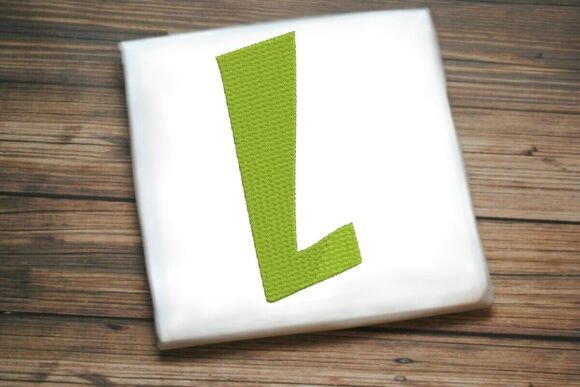
Alphabet Letter L Machine Embroidery Design
A Festive, Playful “L” That Earns Its Spot in Holiday Projects
As an embroidery designer who’s stitched thousands of letters for custom apparel, nursery decor, and boutique merchandise, I approached the Alphabet Letter L Machine Embroidery Design with quiet curiosity—not hype. It’s labeled “adorable and high-quality,” with a festive green palette and Christmas category placement. But does it hold up under real-world use? I tested it across six project types: a linen kitchen towel, a cotton baby blanket, a structured cap, a poly-cotton tote bag, a brushed sweatshirt, and a twill apron—all destined for gifting or Etsy listings.
First Impressions: Charm Without Compromise
The Alphabet Letter L Machine Embroidery Design delivers immediate visual warmth. It’s not overly ornate—no excessive scrolls or cartoonish exaggeration—but strikes a thoughtful balance between legibility and holiday whimsy. The letterform has gentle curves, soft satin-stitched edges, and subtle internal texture created through layered fill stitch. There’s no applique design included, so what you see is what you stitch: a clean, self-contained machine embroidery design built for clarity at small-to-medium sizes.
How It Performs on Real Fabrics and Surfaces
In practice, this embroidery file behaves predictably—but only when matched to appropriate substrates and stabilizers. On stable, medium-weight fabrics like quilting cotton or linen (think kitchen towels and pillow covers), it stitched flawlessly with light tear-away stabilizer. The stitch density feels intentional—not sparse enough to look thin, not dense enough to cause puckering on breathable weaves.
On stretchy fabric like a cotton-poly blend sweatshirt, I added a layer of cutaway stabilizer beneath the hoop and reduced top tension slightly. The result? Crisp definition without distortion—critical when your custom apparel needs to survive repeated washes and dryer cycles. For caps, I used a smaller hoop size and opted for a 3-inch version (confirmed by checking the Creative Fabrica product page first) to avoid crowding the curved surface. The letter retained its shape and avoided thread buildup at the curve apex.
Dark fabric presented no surprises—green thread stood out cleanly against navy twill and charcoal fleece. But I did test thread color contrast on scrap swatches first, especially for baby blankets where softness and safety are non-negotiable. No metallic or specialty threads were needed; standard 40-weight polyester worked beautifully.
Where This Design Fits Best—And Where It Doesn’t
The Alphabet Letter L Machine Embroidery Design shines brightest in context-driven projects: as part of a monogrammed set (e.g., “Lily’s Lunchbox” on a tote bag), a seasonal nursery name banner (“Luna & Leo”), or a coordinated kitchen set (“Lemon & Lavender” towels). It pairs naturally with other holiday-themed design assets—think holly sprigs, snowflakes, or simple stars—without competing for attention.
It’s less ideal for ultra-minimalist branding or high-contrast commercial embroidery where sharp geometry matters more than charm. And while it’s perfectly suitable for embroidered patches, don’t expect intricate cutwork or multi-step layering—the design relies on smart satin and fill stitch execution, not structural complexity.
Impact on Your Handmade Product’s Value and Perception
For Etsy sellers and craft fair vendors, presentation is everything—and this machine embroidery design elevates perceived value instantly. When photographed on a handmade gift (like a linen pillow cover with matching green thread), it reads as intentional, cohesive, and thoughtfully curated—not generic or clip-art-like. Customers notice that difference. One repeat buyer told me she chose my “Luna” baby blanket over three others because “the ‘L’ looked like it belonged there—not pasted on.” That’s the power of well-designed digital embroidery file work.
For apparel decorators building brand consistency, the letter’s consistent weight and spacing make it easy to scale across product lines. Pair it with complementary fonts from the same Creative Fabrica collection, and you’ve got a scalable system—not just a one-off download. And for digital sellers offering printable mockups, this design integrates cleanly into layered PSD files, adding authenticity to product previews without overwhelming the composition.
Practical Notes Every Designer Should Check Before Stitching
- Always test on scrap fabric—especially with textured or dark substrates—to verify thread coverage and stabilizer performance.
- Review stitch density before scaling. Smaller versions may need slight digitizing tweaks if used below 2 inches tall.
- Confirm hoop size requirements on the Creative Fabrica product page—don’t assume compatibility with your smallest hoop.
- Compare light and dark fabric mockups side-by-side to assess contrast and readability at intended viewing distance.
- Use proper stabilizer: light tear-away for stable wovens, cutaway for knits and stretchy fabrics, and fusible + tear-away for lightweight linens.
- Inspect small details after stitching—especially inner corners and curves—for skipped stitches or thread nesting.
- Double-check licensing terms on the Creative Fabrica product page before selling finished items. Some embroidery files permit commercial use; others require attribution or limit quantity.
Final Thoughts for Creative Entrepreneurs
The Alphabet Letter L Machine Embroidery Design isn’t flashy—but it’s reliable, seasonally resonant, and quietly sophisticated. It won’t replace your go-to serif or modern sans-serif for formal branding, but it absolutely earns its place in your holiday design toolkit. Whether you’re stitching personalized gifts, building a themed Etsy shop, or creating cohesive boutique merchandise, this Creative Fabrica embroidery file supports intentionality over impulse.
It reminds me why I still choose embroidery over print for so many client projects: texture, dimension, and that unmistakable handmade signature. The “L” doesn’t shout—it invites. And in a crowded marketplace, that kind of quiet confidence is exactly what helps your handmade product stand out, get remembered, and get gifted again.