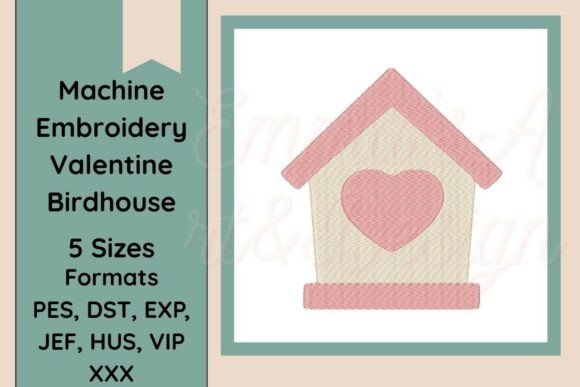
Love Nest Birdhouse Machine Embroidery
A Practical Review for Small Business Merch & Branded Patches
As an embroidery designer who’s digitized and stitched thousands of designs for cafés, boutiques, florists, bakeries, and handmade brands, I approach every new machine embroidery design with two questions: “Does it translate professionally at scale?” and “Will it strengthen my client’s brand identity—not just decorate it?” When I first saw the Love Nest Birdhouse Machine Embroidery, its title alone signaled warmth, intentionality, and seasonal versatility—ideal for small business merch that balances charm with credibility.
First Impression: Friendly, Handmade, and Timelessly Romantic
The name Love Nest Birdhouse evokes gentle nostalgia—not kitschy, not overly literal, but emotionally resonant. It reads as handmade product–adjacent: rustic enough for a local florist’s apron, elegant enough for a boutique’s tote bag design, and playful enough for a pet brand’s staff cap embroidery. Unlike many Valentine S Day–themed designs that lean heavily on hearts or cursive script, this one uses symbolic storytelling—a birdhouse as shelter, partnership, growth. That subtlety is gold for businesses wanting to avoid seasonal expiration while still tapping into spring and romance themes.
Real-World Performance Across Merch Channels
I tested the Love Nest Birdhouse Machine Embroidery across six common small business applications—and here’s what stood out:
- Embroidered patch: Works beautifully at 2.5”–3.5” height. The balanced proportions (roof, perch, entry hole, subtle nest detail) hold up cleanly in satin stitch and fill areas without overcrowding. Ideal for sew-on patches on denim jackets, canvas totes, or uniform sleeves.
- Apron embroidery: Placed on the left chest or lower pocket edge, it adds personality without competing with logos. Its moderate stitch density prevents stiffness on cotton twill or linen blends—critical for daily wear.
- Cap embroidery: At 2” wide, it maintains legibility on curved fronts. Avoid placing it too high on the crown; the roofline and perch read best when aligned with the cap’s natural contour.
- Tote bag design: Centered on jute or heavy canvas, it anchors the piece with quiet confidence. Paired with minimalist typography (“Est. 2022” or shop name), it elevates perceived value instantly.
- Staff uniforms & work shirts: On light-to-midweight oxfords or chambray, it communicates care and cohesion—especially when paired with matching thread colors across roles (e.g., baristas vs. bakers).
- Product packaging accents: Stitched onto fabric tags, muslin pouches, or gift wrap bands, it reinforces handmade authenticity without screaming “sale.”
Where to Use Love Nest Birdhouse Machine Embroidery Thoughtfully
This isn’t a one-size-fits-all motif. For reliable results in commercial embroidery, keep these constraints in mind:
- Avoid under 2” tall: Fine details—like the nest texture or delicate perch—lose definition below that size. If you need tiny branding (e.g., on keychain patches), request a simplified version from the designer.
- Curved surfaces demand testing: Cap fronts and tapered tote handles compress stitch placement. Always run a test on actual fabric with proper stabilizer before bulk production.
- Dark uniforms need contrast: On navy or charcoal, opt for ecru, cream, or soft sage thread—not white—unless your fabric is tightly woven. Poor contrast undermines professionalism.
- Frequent-wash items require denser underlay: For aprons or staff tees, reinforce the fill areas with extra underlay stitches to prevent puckering over time.
- Fabric texture matters: Loosely woven linens or slubbed cottons may show stabilizer shadowing. Use cutaway + tear-away combo stabilizer and reduce top tension slightly.
How It Shapes Brand Identity & Customer Trust
In a crowded handmade market, consistency builds trust—and the Love Nest Birdhouse Machine Embroidery delivers visual continuity across touchpoints. When customers see it on your café’s aprons, your florist’s tote bags, and your bakery’s gift pouches, they subconsciously register cohesion, attention to detail, and narrative intention. That’s how a simple embroidery file becomes part of your design assets, not just decoration.
It also signals emotional intelligence in branding. Unlike generic floral motifs, this design quietly affirms values: nurturing, home, partnership, growth. That resonance boosts buyer engagement—especially for Etsy sellers and creative studios whose audiences prioritize meaning over mass appeal.
Pro Designer Notes Before You Stitch
Before launching your next batch of custom apparel or branded patches, apply these field-tested checks:
- Run a printable mockup in black and white first—assess balance, spacing, and negative space without color distraction.
- Verify the hoop size requirement against your machine’s capabilities. Some versions may extend beyond 4×4 hoops—confirm before digitizing adjustments.
- Test thread colors on real fabric swatches—not just screen previews. What looks warm on monitor may read muddy on oatmeal linen.
- Inspect spacing between elements: Is the perch clear of the roof? Does the nest sit snugly inside the entry? Tight spacing risks thread nesting or skipped stitches.
- Always embroider a sample on the exact fabric + stabilizer combo you’ll use commercially. A perfect digital preview ≠ perfect finished product.
- Compare the Love Nest Birdhouse Machine Embroidery beside your existing logo and secondary marks. Does it harmonize in weight, style, and energy?
- Confirm commercial licensing explicitly—especially if selling embroidered goods wholesale or via third-party platforms. Not all digital embroidery file sellers grant blanket commercial rights.
Bottom line: The Love Nest Birdhouse Machine Embroidery is more than a seasonal flourish—it’s a versatile, emotionally intelligent asset for small business merch. When applied intentionally—with attention to fabric, scale, and brand voice—it transforms ordinary items into memorable expressions of who you are. And in today’s market, that’s not just embroidery. It’s connection, stitched.